Radiometer logo

POCT Improves Care Timelines in the Emergency Department

POCT Improves Care Timelines in the Emergency Department

Register now

May 6, 2026 - 3:00 PM CET (Paris, Berlin, Copenhagen)

▶ Pre-webinar (live)

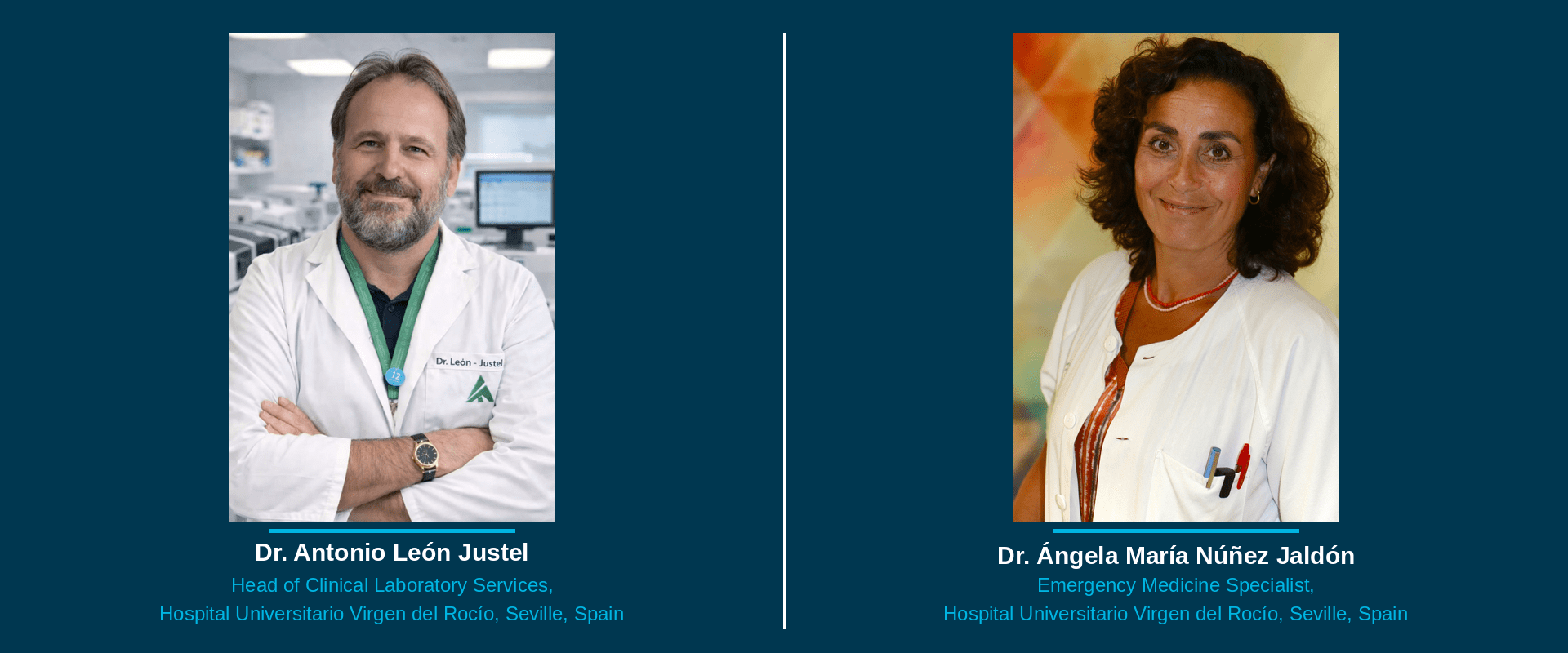
Webinar presented by Dr. Antonio León Justel, Head of Clinical Laboratory Services, Hospital Universitario Virgen del Rocío, Seville, Spain; and Dr. Ángela María Núñez Jaldón, Emergency Physician, Hospital Universitario Virgen del Rocío, Seville, Spain.

About this webinar

Timely clinical decision-making in the emergency department depends on fast, reliable access to diagnostic results. Delays in obtaining key laboratory values — including creatinine and urea — can significantly slow patient assessment and disposition, placing additional pressure on already stretched ED teams.

Point-of-care testing (POCT) brings diagnostics directly to the patient’s bedside, eliminating time lost to central laboratory workflows. The published POCTUR multicenter randomized clinical trial evaluated the impact of creatinine and urea POCT on care timeliness in emergency department settings, generating robust evidence to support the adoption of POCT in acute care. The trial enrolled 3,200 patients across multiple sites and demonstrated significant, measurable improvements in time to clinical decision when POCT was used.


During this webinar, Dr. Antonio León Justel and Dr. Ángela María Núñez Jaldón will present the POCTUR trial findings alongside real-world clinical perspectives on POCT implementation in the emergency department including:

  • The design and key findings of the POCTUR multicenter randomized clinical trial

  • The measurable impact of bedside creatinine and urea testing on care timeliness and patient flow in the ED

  • The clinical role of kidney function markers alongside blood gas analysis in supporting timely decision-making for critically ill patients

  • Practical considerations for integrating POCT into real-world emergency department workflows


About the speakers

Dr. Antonio León Justel

Head of Clinical Biochemistry

Hospital Universitario Virgen del Rocío, Seville, Spain

Dr. Antonio León Justel is Head of Clinical Laboratory Services at Hospital Universitario Virgen del Rocío, Seville, Spain. He holds a degree in Pharmacy and a PhD in Clinical Biochemistry and Molecular Biology from the University of Seville. With extensive experience in laboratory medicine and healthcare management, his work focuses on laboratory diagnostics and the integration of innovative diagnostic technologies to improve clinical decision-making and patient care. He is the principal investigator and lead author of the POCTUR multicenter randomized clinical trial, published in Clinical Chemistry and Laboratory Medicine (2025), which demonstrated that POCT significantly improves care timeliness in the emergency department.


Dr. Ángela María Núñez Jaldón

Emergency Physician & Faculty Quality Secretary

Hospital Universitario Virgen del Rocío, Seville, Spain

Dr. Ángela María Núñez Jaldón is an emergency medicine specialist within the Clinical Management Unit of Critical Care and Emergencies at Hospital Universitario Virgen del Rocío (HUVR) in Seville, where she also serves as Faculty Quality Secretary, a role dedicated to improving care delivery and patient safety across the hospital. She holds a PhD (Cum Laude, 2024) from the University of Seville, with doctoral research focused on the analysis and optimization of emergency department processes, including real-world application during the COVID-19 pandemic. She leads and participates in several publicly funded research projects developing AI-powered decision support tools for ED patient flow management and serves as Secretary of the Clinical Simulation Commission at HUVR. 


Who should attend?

      Emergency physicians and emergency medicine specialists
      Nurses and advanced practice providers in emergency care settings
      Clinical laboratory professionals and point-of-care coordinators


This webinar will:


  • Present the methodology and key findings of the POCTUR multicenter randomized clinical trial on POCT in the emergency department

  • Examine how bedside creatinine and urea testing reduces time-to-result and accelerates clinical decision-making in the ED

  • Explore the clinical role of rapid kidney function markers alongside blood gas testing for assessing critically ill patients

  • Share real-world perspectives on POCT implementation from emergency care professionals

  • Provide practical guidance on integrating POCT as part of an evidence-based acute care strategy


Session format

     •     15 minutes of live Q&A with the speakers

  • 40 minutes of expert presentations combining clinical evidence on care timeliness with practical insights into kidney function testing in acute care


Cookies are used on this website

Use of cookies
Confirm your account with Radiometer

Please enter a valid email

CONTINUE
By submitting your e-mail you agree to the data policy notice
Radiometer is using Microsoft Azure Active Directory to authenticate customer access. If you are already registered you will be taken to Microsoft AD to sign in using your Microsoft AD credentials.
You are already registered
Radiometer is using Microsoft Azure AD to authenticate customer access. If you are already registered you will be taken to AZURE to sign in using your AZURE credentials.
Thank you

We will be sending an e-mail invitation to you shortly to sign in using Microsoft Azure AD.

Radiometer is using Microsoft Azure AD to authenticate customer access.
Sorry

It seems that your e-mail is not registered with us

Radiometer is using Microsoft Azure AD to authenticate customer access. If your e-mail is not registered with us please click CONTINUE and we will guide you through the sign-in process.
We have previously sent an invitation by e-mail

Please click "Get started" in the e-mail to complete the registration process

Radiometer is using Microsoft Azure AD to authenticate customer access.
Sorry

We were not able to process your request due to a communication error

Sorry

It seems this account has not been given access to the portal

Radiometer is using Microsoft AZURE Active Directory to authenticate users

Radiometer uses Azure AD to provide our customers and partners secure access to documents, resources, and other services on our customer portal.

If your organization is already using Azure AD you can use the same credentials to access Radiometer's customer portal.

Key benefits

       
  • Allow the use of existing Active Directory credentials
  • Single-sign on experience
  • Use same credentials to access future services

Request access

You will receive an invitation to access our services via e-mail when your request has been approved.

When you accept the invitation, and your organization is already using AZURE AD, you can use the same credentials to access Radiometer's customer portal. Otherwise, a one-time password will be sent via e-mail to sign in.