Radiometer logo

Hiroshima University Hospital

Improving patient-sample traceability and workflow efficiency with 1st Automatic

  • Download full story
    Download the full story

    Contact Info


    By submitting this form, I acknowledge that I have reviewed and understood the data privacy notice.

    All fields must be filled!

Handling nearly 4,000 ambulance arrivals and 24,000 blood gas measurements annually, Hiroshima University Hospital’s Advanced Emergency and Critical Care Center needed to improve patient-sample traceability and streamline blood gas testing.

Since implementing 1st Automatic five years ago, the Center has eliminated analyzer queues, increased staff confidence, and freed up more time for patient care.

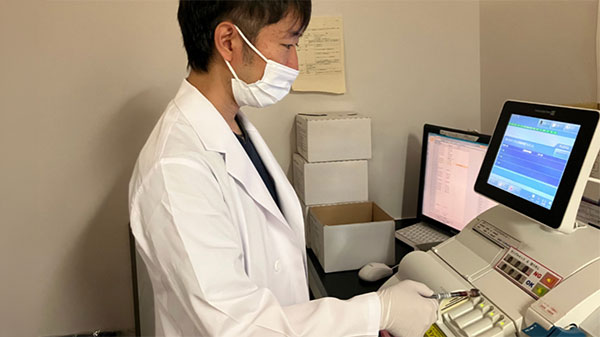
Dr. Kikutani from Hiroshima University Hospital

Dr. Kikutani measuring the linked sample with the blood gas analyzer
When patient-sample matching happens away from the bedside

In the previous workflow, samples were collected at the bedside and then transported to the analyzer, where the caregiver manually selected the patient record before running the test. This meant patient-sample matching often occurred away from the bedside, sometimes while multiple samples were being handled at once.

During busy periods, manual selection and queues at the analyzer increased the risk of missed steps, samples being tested in the wrong order, or results being assigned to the wrong patient. Such errors could also be difficult to detect when patients had similar result trends.

Automating blood gas testing with 1st Automatic

1st Automatic links the sample to the patient at the bedside, at the time of collection, reducing opportunities for mislabeling errors. Once the sample reaches the ABL800 FLEX, clinicians can simply load it onto the FLEXQ module for automated mixing and measurement using Drop’n’Go.

Even when carrying multiple samples, the workflow helps ensure the right result is linked to the right patient, allowing staff to return promptly to the bedside.

For healthcare professionals caring for critically ill patients, this means less time spent at the analyzer and more time available for direct patient care.

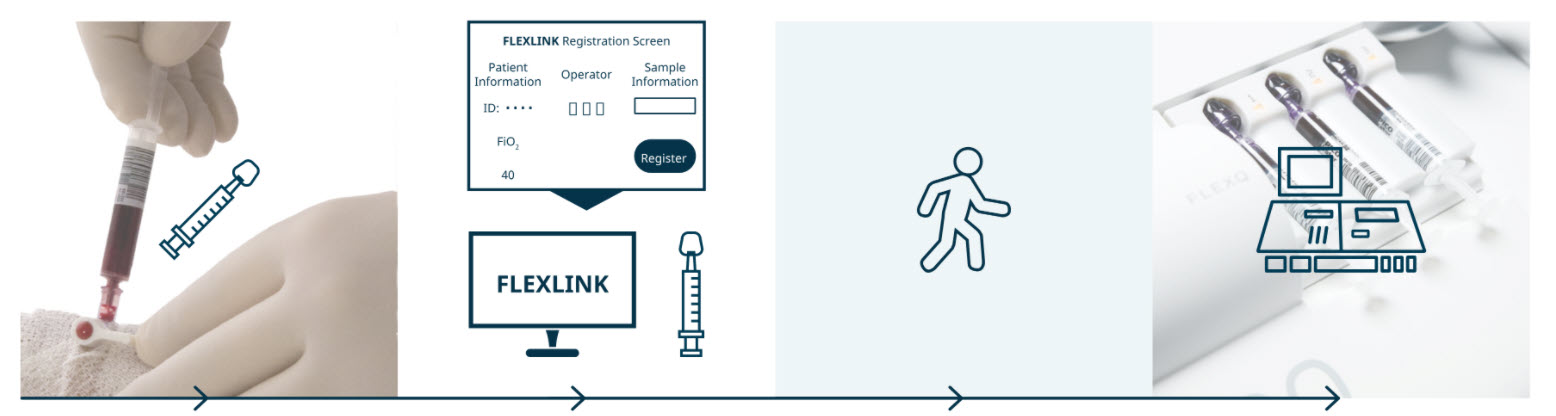
Four-step blood gas testing workflow using FLEXLINK and the FLEXQ module

Blood gas sample drawn by staff

Linking the operator, sample, and patient IDs at the bedside through the FLEXLINK registration screen

Transportation of the linked sample to the blood gas analyzer

Drop’n’Go up to three samples on the FLEXQ module for automatic scanning, mixing, and sample measurement. Data is automatically transferred to the right patient.

Download the full story from Hiroshima University Hospital

Learn more about how Hiroshima University Hospital has achieved a meaningful improvement in the reduction of patient-sample mix-ups with the 1st Automatic solution.
Download the full story

Contact Info


By submitting this form, I acknowledge that I have reviewed and understood the data privacy notice.

All fields must be filled!

Hiroshima University Hospital’s Advanced Emergency and Critical Care Center

  • 4,000 ambulance arrivals and ~ 24,000 blood gas measurements annually
  • 49 departments and 742 beds
  • Radiometer products:
    • ABL800 FLEX
    • 1st Automatic
    • AQURE POC IT solution
    • safePICO Aspirator

MAPSSS-001421 R2

Cookies are used on this website

Use of cookies
Confirm your account with Radiometer

Please enter a valid email

CONTINUE
By submitting your e-mail you agree to the data policy notice
Radiometer is using Microsoft Azure Active Directory to authenticate customer access. If you are already registered you will be taken to Microsoft AD to sign in using your Microsoft AD credentials.
You are already registered
Radiometer is using Microsoft Azure AD to authenticate customer access. If you are already registered you will be taken to AZURE to sign in using your AZURE credentials.
Thank you

We will be sending an e-mail invitation to you shortly to sign in using Microsoft Azure AD.

Radiometer is using Microsoft Azure AD to authenticate customer access.
Sorry

It seems that your e-mail is not registered with us

Radiometer is using Microsoft Azure AD to authenticate customer access. If your e-mail is not registered with us please click CONTINUE and we will guide you through the sign-in process.
We have previously sent an invitation by e-mail

Please click "Get started" in the e-mail to complete the registration process

Radiometer is using Microsoft Azure AD to authenticate customer access.
Sorry

We were not able to process your request due to a communication error

Sorry

It seems this account has not been given access to the portal

Radiometer is using Microsoft AZURE Active Directory to authenticate users

Radiometer uses Azure AD to provide our customers and partners secure access to documents, resources, and other services on our customer portal.

If your organization is already using Azure AD you can use the same credentials to access Radiometer's customer portal.

Key benefits

       
  • Allow the use of existing Active Directory credentials
  • Single-sign on experience
  • Use same credentials to access future services

Request access

You will receive an invitation to access our services via e-mail when your request has been approved.

When you accept the invitation, and your organization is already using AZURE AD, you can use the same credentials to access Radiometer's customer portal. Otherwise, a one-time password will be sent via e-mail to sign in.